dnd hunter's mark is a 1st-level Divination spell that marks one creature, adds 1d6 damage when you hit that target, and helps you track it. This guide gives you the fast rules, the 2014 vs 2024 differences, the concentration trap, and a practical way to show the mark on VTT tokens.
I am treating this as a spell encyclopedia page for Rangers, not a hype piece. The short version from my tables: Hunter's Mark is good when the target lives long enough for repeated attacks, and mediocre when it steals concentration or bonus actions from better plays.
| Need-to-know point | Fast answer |
|---|---|
| Spell level / school | 1st-level Divination. |
| Casting time / range | Bonus Action / 90 feet. |
| Components | Verbal only. |
| Duration | Concentration, up to 1 hour. Higher slots extend duration, not damage. |
| 2014 damage trigger | Extra 1d6 damage when you hit the marked target with a weapon attack. |
| 2024 damage trigger | Extra 1d6 Force damage when you hit the marked target with an attack roll. |
| Best use | Mark one durable enemy you expect to hit multiple times before concentration breaks. |
DND Hunter's Mark Quick Rules
DND Hunter's Mark is a bonus-action concentration spell that rewards repeated hits against one marked target. The 2014 Basic Rules version and the 2024 Free Rules version share the same basic shape, but the 2024 wording is broader and cleaner for modern Ranger play.
- You must see the creature when you cast the spell or move the mark to a new target.
- The spell needs concentration. A broken concentration check ends the mark unless a later feature says otherwise.
- The tracking benefit is narrow but real. It gives Advantage on Wisdom (Perception or Survival) checks you make to find the marked target.
- Moving the mark costs a Bonus Action. You only get to move it after the target drops to 0 HP before the spell ends.
- Upcasting extends the timer. A level 3-4 slot can last up to 8 hours; a level 5+ slot can last up to 24 hours.
What Changed in 2024 Hunter's Mark?
In 2024, Hunter's Mark changed from a weapon-attack damage rider into a Force-damage rider that works whenever you hit the marked target with an attack roll. That is the rules difference most likely to matter at the table.
| Question | 2014 Hunter's Mark | 2024 Hunter's Mark |
|---|---|---|
| Damage type | The spell adds 1d6 damage but does not name Force damage. | The spell adds 1d6 Force damage. |
| Trigger | You hit the target with a weapon attack. | You hit the target with an attack roll. |
| Spell attacks | Normally no, because the trigger is weapon attacks. | Yes, if the spell attack includes an attack roll and you are hitting the marked target. |
| Moving the mark | Bonus Action on a subsequent turn after the target drops to 0 HP. | Bonus Action after the target drops to 0 HP, with the "subsequent turn" wording removed. |
| Ranger support | It is a Ranger spell, but not the whole class engine. | 2024 Ranger gives free casts and later features that improve Hunter's Mark. |
The 2024 Ranger leans hard into the spell. Favored Enemy gives free casts, Relentless Hunter stops damage from breaking concentration on it at level 13, Precise Hunter gives Advantage against the marked creature at level 17, and Foe Slayer turns the die into a d10 at level 20.
When Is Hunter's Mark Worth Casting?
Hunter's Mark is worth casting when one target will survive long enough for multiple hits and you are not giving up a stronger concentration plan. If the fight is short, crowded with weak enemies, or already demanding your Bonus Action, the spell can underperform.
| Situation | Use it? | Why |
|---|---|---|
| Single boss or elite monster | Usually yes. | The target lives long enough for repeated attacks. |
| Level 5 Ranger with Extra Attack | Often yes. | Two attacks make the 1d6 rider easier to cash in. |
| Many low-HP enemies | Usually no. | You keep spending Bonus Actions to move the mark instead of ending threats. |
| Two-weapon or bonus-action-heavy build | Be careful. | The spell competes with the same Bonus Action your build wants every round. |
| Need control, stealth, or terrain magic | Often no. | Pass without Trace, Spike Growth, Entangle, or Summon Beast may win the encounter more cleanly. |
The quick math is simple: one Hunter's Mark hit is only 3.5 average damage before accuracy. At two hits per round it starts feeling better, but the real cost is not the spell slot. The real cost is concentration, Bonus Action timing, and the Ranger spell you are not concentrating on.
Why Hunter's Mark Can Become a Trap
Hunter's Mark becomes a trap when you cast it by habit instead of checking concentration and Bonus Action pressure. The linked video at the bottom is about Hex, but the lesson transfers directly: a 1d6 damage rider looks cheap until it blocks the turn you actually needed.
- Concentration is crowded. Rangers have real alternatives, especially Pass without Trace, Spike Growth, Entangle, Silence, and summons.
- Bonus Actions are crowded. Moving Hunter's Mark can fight with off-hand attacks, subclass commands, mobility features, and emergency healing.
- Damage is target-dependent. A marked enemy that dies before your next turn gave you almost no return.
- Getting hit matters. Before level 13 in 2024, damage can still break concentration on Hunter's Mark.
If concentration checks are the weak point in your build, pair this article with the D&D Constitution guide. If you are comparing Ranger concentration options, the DND druid spells guide is also useful because many nature-control spells compete for the same mental slot.
Common DND Hunter's Mark Rulings
Most Hunter's Mark arguments come from trigger wording, range assumptions, and whether the mark is a tracking tool or a reveal spell. Set these rulings once and the spell becomes much easier to run.
Does Hunter's Mark work on every hit?
Yes, if the hit matches your rules version's trigger. In 2014, that means weapon attacks. In 2024, that means attack rolls. A level 5 Ranger who hits twice can add the die twice.
Does Hunter's Mark double on a critical hit?
Most tables double the Hunter's Mark damage die on a critical hit because it is extra damage from the hit. Do not extend that into every reroll feature automatically. If a feature only rerolls weapon damage dice, many tables leave the Hunter's Mark die alone.
Can you move Hunter's Mark for free?
No. Moving Hunter's Mark costs a Bonus Action, and the previous marked target must have dropped to 0 HP before the spell ended. You do not spend a new spell slot to move it, but you do spend the Bonus Action.
Does the target leaving 90 feet end Hunter's Mark?
No. The 90-foot range is for choosing or moving the mark. Once the spell is active, leaving that range does not automatically end it. Concentration, duration, and valid transfer timing matter more.
Does Hunter's Mark reveal an invisible or hidden target?
No. Hunter's Mark helps you find the target, but it does not automatically reveal it. You get Advantage on the relevant Perception or Survival check; the DM still resolves hiding, invisibility, cover, tracks, and scene logic.
How to Track Hunter's Mark on VTT Tokens
The cleanest VTT setup is one visible mark on the target and one separate concentration reminder on the Ranger. Do not rely on memory when the fight has summons, conditions, and multiple damage riders.
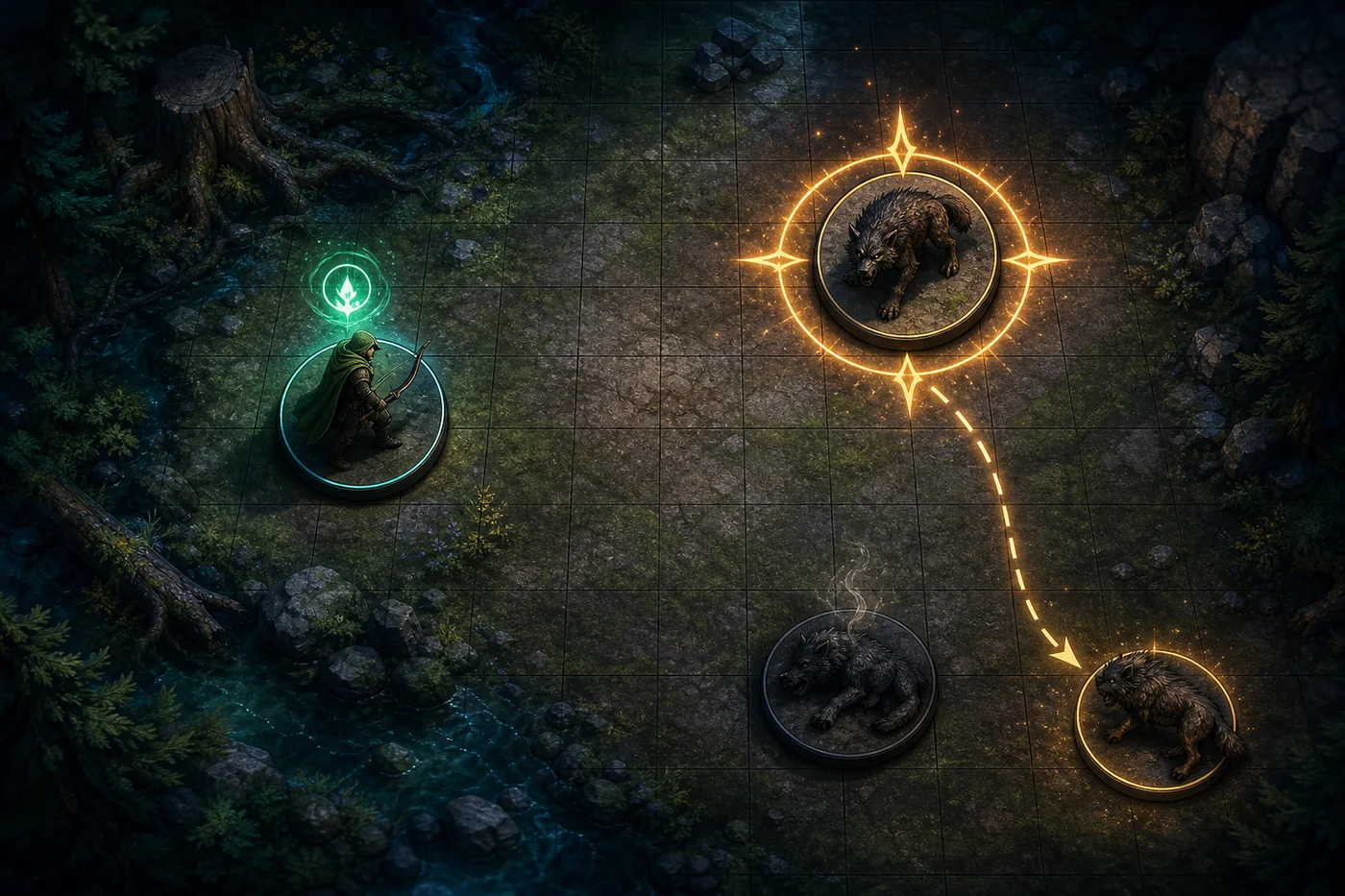
- Use a high-contrast target ring. Amber, teal, or white reads better than a tiny icon on a dark map.
- Keep concentration on the Ranger token. The target marker is not enough when the Ranger gets hit.
- Make the marker reusable. A simple quarry ring or corner badge works across monsters, bosses, and chase scenes.
- Avoid covering the creature art. Put the mark around the portrait or base so the monster silhouette stays readable.
- Use one marker language for the campaign. If Hunter's Mark, Hex, and curses all look different, players stop asking "which 1d6 is this?"
You can build a clean Ranger or marked-target portrait in the Token Maker editor. If you want to test the expected damage swing, keep the D&D dice roller open and compare one hit, two hits, and a missed Bonus Action turn. For broader character planning, start with the DND classes guide or the spell-guide pattern in DND Mage Armor.
Player and DM Cheat Sheet
The easiest way to run Hunter's Mark quickly is to use the same table phrases every time. That keeps the spell from turning into a mid-combat rules search.
| Moment | Say this at the table |
|---|---|
| Casting | "Bonus Action: I mark that visible creature and start concentrating." |
| Hit | "The attack hits, so I add Hunter's Mark damage." |
| Target drops | "The marked target is at 0 HP; I can move the mark with a Bonus Action before the spell ends." |
| Ranger takes damage | "I need a concentration save unless my feature prevents this from breaking Hunter's Mark." |
| Target hides | "Hunter's Mark does not reveal it, but I have Advantage on checks to find it." |
FAQ About DND Hunter's Mark
Is Hunter's Mark concentration?
Yes. Hunter's Mark requires concentration for up to 1 hour, unless a specific feature changes how concentration works for that spell.
Does Hunter's Mark trigger on every hit?
It works on every hit that matches the trigger. In 2014, that means weapon attacks. In 2024, it means hits with attack rolls.
Can you move Hunter's Mark after the target drops to 0 HP?
Yes. If the marked target drops to 0 HP before the spell ends, you can spend a Bonus Action to move the mark to a new visible creature within range.
Does Hunter's Mark reveal the target?
No. Hunter's Mark gives Advantage on checks to find the marked creature, but it does not automatically reveal an invisible or hidden target.
Is upcasting Hunter's Mark worth it?
Usually only when the extended duration matters across multiple scenes. Upcasting Hunter's Mark extends concentration duration; it does not increase the 1d6 damage die.
Watch: Why the Hex Trap Matters for Hunter's Mark
The video from the keyword sheet is Hex is a trap in D&D 5E - Advanced guide to Hex. It is not a Hunter's Mark tutorial, but the useful idea is the same: a small damage rider can look automatic while quietly spending concentration and Bonus Actions. Use that lens before you mark every goblin in the room.