
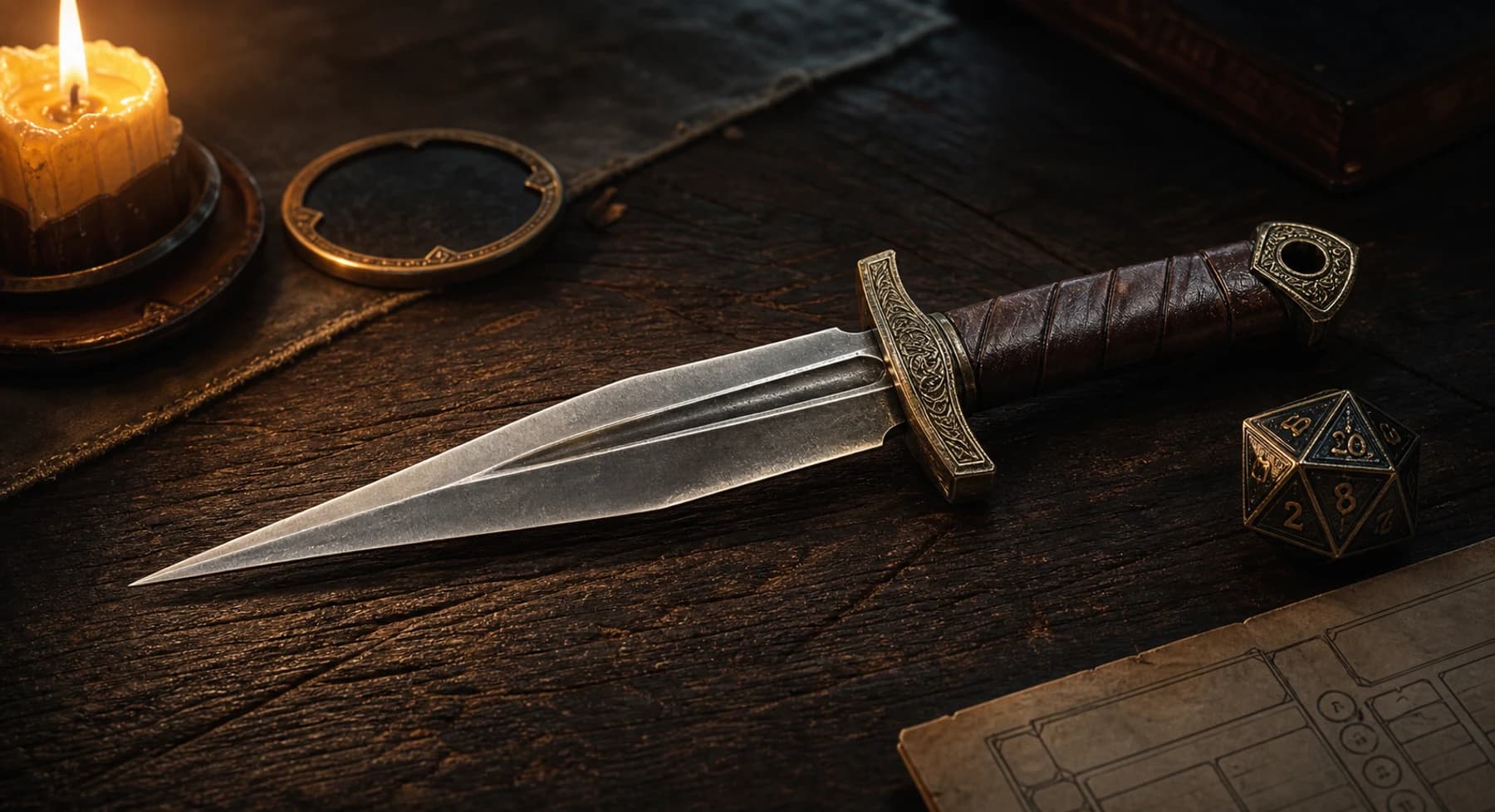
dnd dagger is a simple melee weapon that deals 1d4 piercing damage, costs 2 gp, weighs 1 lb, and carries the Finesse, Light, and Thrown properties. This is an equipment encyclopedia page with practical table advice: you get the stat block first, then the rulings that decide whether a dagger is a backup tool, a Rogue delivery system, or part of a 2024 Nick build.
| Dagger stat | Fast answer |
|---|---|
| Weapon category | Simple melee weapon. |
| Damage | 1d4 piercing. |
| Cost / weight | 2 gp / 1 lb. |
| Properties | Finesse, Light, Thrown. |
| Thrown range | 20 feet normal, 60 feet long range. |
| 2024 weapon mastery | Nick, if your character has the right mastery access. |
| Best users | Rogues, Dex characters, casters who need an emergency weapon, and two-weapon builds that care about Light/Nick. |
My short table opinion: a dagger is not a damage race winner. It is good because it is cheap, concealable, throwable, Dexterity-friendly, and easy to keep as a backup. That mix is why it keeps showing up on character sheets even when a rapier or shortsword hits harder.
dnd dagger Quick Stats
A dnd dagger is a simple melee weapon with 1d4 piercing damage, Finesse, Light, and Thrown 20/60. The 2014 Basic Rules weapon table gives the classic fifth-edition stat line, while the 2024 Free Rules equipment section keeps the same basic weapon identity and adds weapon mastery context.
- Finesse: use Strength or Dexterity for attack and damage, whichever fits the attack.
- Light: works with two-weapon fighting rules when the other weapon also qualifies.
- Thrown: you can throw it as a ranged attack using the same ability you would use for melee.
- Simple weapon: many classes can use it without building around weapon access.
- Small profile: it is easy to justify as a boot knife, sleeve blade, belt tool, or last-resort weapon.
How Much Damage Does a dnd dagger Do?
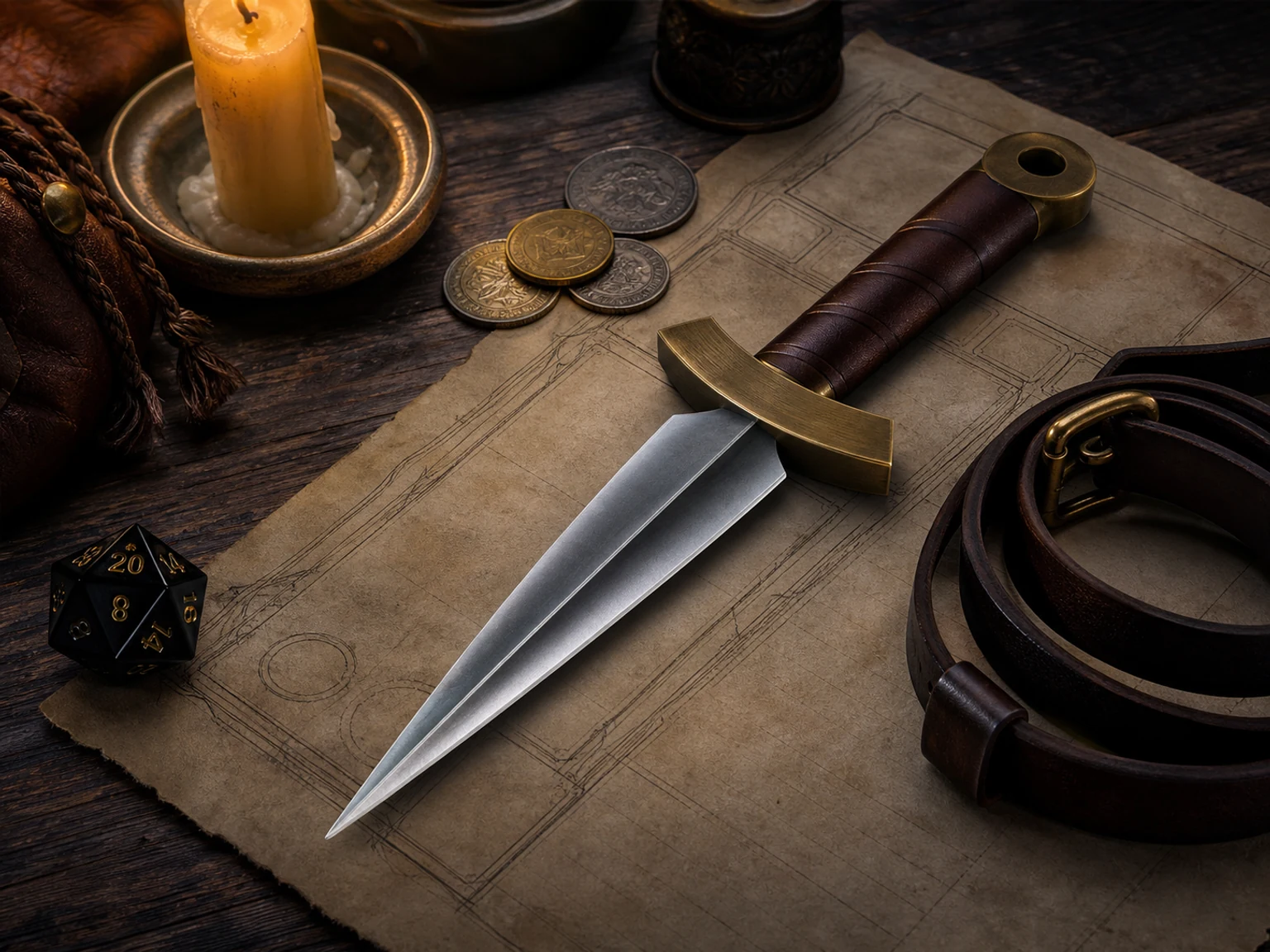
A dnd dagger deals 1d4 piercing damage plus the relevant ability modifier when the attack rules allow that modifier. The base die is small, so most dagger value comes from class features, extra attacks, off-hand timing, poison, Sneak Attack, or simply having a weapon when your main plan fails.
| Use case | Typical damage logic | Table note |
|---|---|---|
| One melee attack | 1d4 + Str or Dex modifier. | Finesse lets a Dex character use the better stat. |
| One thrown attack | 1d4 + Str or Dex modifier. | Normal range is 20 feet; long range is 60 feet with disadvantage. |
| 2014 off-hand attack | Usually 1d4 without the ability modifier unless a feature says otherwise. | Costs the bonus action under common 2014 two-weapon fighting rules. |
| 2024 Nick setup | Can move the extra Light attack into the Attack action if you have Nick mastery. | Nick changes action economy; it does not turn the dagger into a high-die weapon. |
| Rogue Sneak Attack | Dagger damage plus Sneak Attack dice when the normal Sneak Attack conditions are met. | The dagger die is small, but Sneak Attack carries the hit. |
When I test a dagger build at the table, I do not ask "is 1d4 impressive?" It is not. I ask whether the dagger creates a second route: can I attack with Dex, throw from cover, keep my bonus action plan, or still threaten an enemy after being disarmed?
Is a dnd dagger Good for Rogues?
Yes, a dnd dagger is good for Rogues as a backup, thrown option, and Sneak Attack delivery weapon, but it is rarely the highest-damage main weapon. A rapier usually wins the single-hit melee damage comparison, and a shortbow often wins simple ranged reliability.
The dagger still has real Rogue value:
- It works with Sneak Attack. The Finesse property keeps it eligible when the rest of the Sneak Attack conditions are met.
- It can be thrown. A Rogue can threaten a target without changing to a bow.
- It supports hidden-weapon fiction. This matters in prison breaks, noble parties, cult infiltrations, and urban sessions.
- It is cheap enough to lose. Throwing a 2 gp dagger into a canal hurts less than losing a magic weapon.
- It pairs with two-weapon play. In 2024-style rules, Nick can matter a lot if your Rogue has the mastery path to use it.
My preference is simple: give the Rogue a rapier or shortsword for normal fights, then carry two to four daggers for weird fights. The dagger is the tool you are happy you brought when the plan stops being clean.
What Changed for dnd dagger in the 2024 Rules?
The biggest 2024 dagger change is not the damage die; it is the Nick weapon mastery option for characters who can use weapon mastery. The dagger remains a low-damage, flexible simple weapon, but the action economy around Light weapons changed enough that older advice can mislead players.
| Question | 2014-style answer | 2024-style answer |
|---|---|---|
| Does the dagger still deal 1d4 piercing? | Yes. | Yes. |
| Does it still have Finesse, Light, and Thrown? | Yes. | Yes. |
| What is the main build change? | Bonus-action two-weapon fighting is the common dagger trick. | Nick mastery can shift the extra Light attack into the Attack action. |
| Does every character get Nick? | No weapon mastery system in the 2014 Basic Rules. | No. You need a class feature or option that grants the relevant mastery. |
If your group is mixing old character sheets with newer rules, write "dagger: Nick?" directly on the sheet. That one note prevents the common mistake where a player assumes the dagger automatically grants a free extra attack.
When Should You Throw a dnd dagger?
You should throw a dnd dagger when staying in position is worth more than keeping the dagger in your hand. The range is short enough that throwing is a tactical patch, not a replacement for a real ranged weapon.
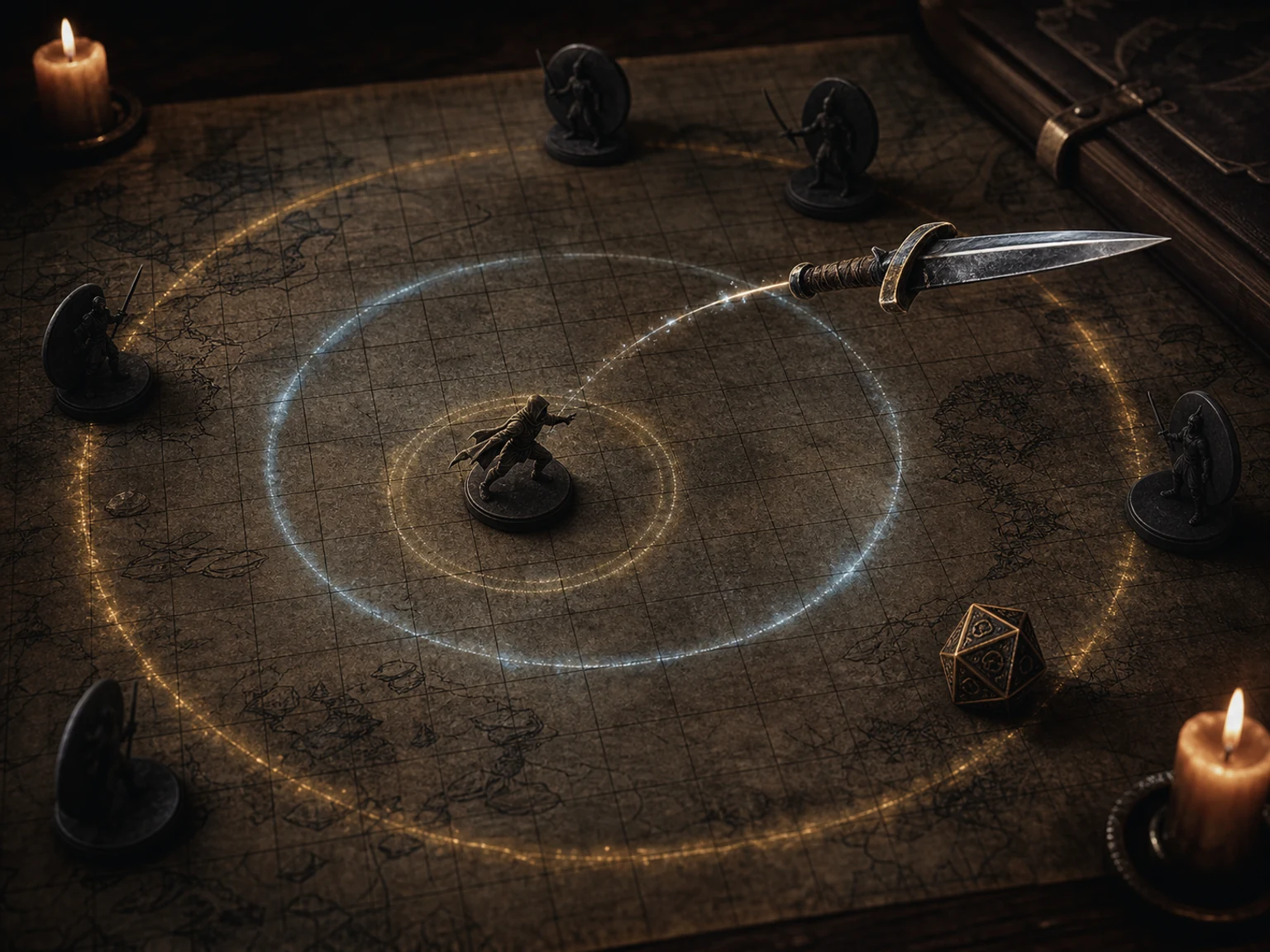
- Throw from cover when stepping into melee would expose your concentration caster or wounded Rogue.
- Throw at a fleeing enemy if the target is just outside reach and a small hit could matter.
- Throw to trigger a class feature only after confirming the feature works with the attack type.
- Do not throw your last blade unless the scene is worth being empty-handed afterward.
- Do not use it as your only ranged plan if your build regularly fights beyond 20 feet.
Use the D&D dice roller to test the difference between a normal 20-foot throw and a long-range 60-foot throw with disadvantage. The math makes the decision obvious fast.
How Many Daggers Should a Character Carry?
Most dagger-using characters should carry two to four daggers; a dedicated thrown-weapon character may want six or more. The right number depends on whether the dagger is a backup, a roleplay prop, or an actual damage plan.
| Character type | Recommended count | Why |
|---|---|---|
| Wizard, Sorcerer, common backup user | 1-2 | Enough for emergencies without pretending the dagger is the build. |
| Rogue or Dex Fighter | 2-4 | One main backup, one off-hand, and one or two throwaways. |
| Thrown-weapon specialist | 6+ | You need enough blades to survive multi-round fights, missed throws, and retrieval problems. |
| Infiltration character | 1 obvious, 1 hidden | The hidden dagger is the real value, not a bigger damage die. |
Ask your DM how strictly they track drawing, dropping, recovering, and concealing weapons. At strict tables, the logistics are the build. At loose cinematic tables, the dagger is mostly a clean fiction tool.
dnd dagger vs Shortsword vs Rapier
A dnd dagger is more flexible than a shortsword or rapier, but it deals less weapon-die damage. Pick the dagger for backup utility, not because it wins a fair damage spreadsheet.
| Weapon | Why pick it | Why skip it |
|---|---|---|
| Dagger | Simple, finesse, light, thrown, easy to conceal, cheap to replace. | Only 1d4 base damage. |
| Shortsword | Better damage die and still works well for many Dex melee characters. | Not as easy to justify as a hidden tool; not thrown by default. |
| Rapier | Best common finesse die for one-handed melee damage. | Not light, not thrown, and much less subtle. |
If you are still deciding the character chassis, start with the DND classes guide. If the dagger user is getting hit too often, the DND armor guide will matter more than squeezing one more point of dagger damage.
How to Show a dnd dagger on a VTT Token
A dnd dagger VTT token should make the blade readable without turning the portrait into a tiny gray line. At map scale, silhouette beats realism.
When I make a knife-fighter token, I usually place the dagger near the face, shoulder, or leading hand. A dagger hanging at the belt often disappears once the token shrinks to 256 or 512 px.
- Use a bright edge highlight so the blade does not vanish on dark dungeon maps.
- Keep the hand pose clear if the dagger defines the character's role.
- Avoid full-body crops for dagger specialists; the weapon becomes unreadable.
- Use a stealthy frame for Rogues and assassins, not a heavy heroic border.
- Export a clean square token if the portrait is headed to Roll20, Foundry VTT, or Owlbear Rodeo.
You can build that look in the VTT token maker. For grid-first portraits, use the square token maker so the dagger hand does not get cropped off by accident.
FAQ About dnd dagger
Is a dnd dagger a simple weapon?
Yes, a dnd dagger is a simple melee weapon. That is why it appears on so many character sheets even when the character is not a dedicated martial build.
Can a Rogue use Sneak Attack with a dagger?
Yes, a Rogue can use Sneak Attack with a dagger when the normal Sneak Attack conditions are met. The important part is that the dagger has the Finesse property.
Can you throw a dnd dagger with Dexterity?
Yes, a thrown dagger can use Dexterity because the weapon has Finesse. It uses the same ability choice you would have for a melee attack with that dagger.
Is a dagger better than a shortsword?
No for raw damage, yes for flexibility. A shortsword hits harder, but a dagger is cheaper, throwable, easier to hide, and more useful as a backup tool.
Does the 2024 Nick mastery make daggers strong?
Nick makes daggers more action-efficient for the right character, but it does not change the 1d4 damage die. It is a build enabler, not a universal damage upgrade.
Watch the dnd dagger Video
For real-world dagger background rather than game rules, the dagger overview on Wikipedia is useful context. For table play, always come back to the weapon table your campaign is actually using.